
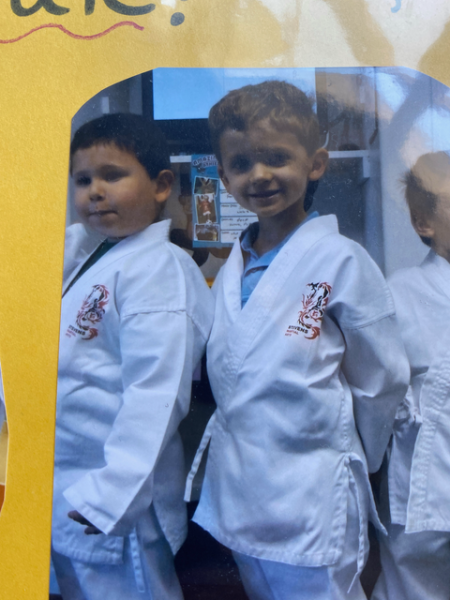
 I don’t doubt that martial arts is a rather uncommon sport in the United States. A lot of families will have their children in young years shake off their extra energy in age old American activities such as shooting hoops in basketball, striking a baseball with all their might, and weaving between defenders in soccer. These sports are usually what children grow up to continue playing in their high school and even college years. You don’t see as many young adults partaking in karate, taekwondo, and more. However, it seems that the majority of people you ask about past involvement in martial arts will admit that they have attended classes, if only for a couple months. Strange coincidence? I think you’ll find that this actually goes deeper than just an obscure yet oddly common hobby for Cresskill youths.
Why is it so common? Well, for most families in Cresskill, it seriously just boils down to one thing: a place to leave the kids for a couple hours. Ryan Honczarenko, a senior at Cresskill High School, admits that “I wasn’t really learning much about martial arts, it acted more like a babysitting spot.”
Pretty underwhelming, I know. But hold on. It’s not completely in vain. A good amount of the people asked about what martial arts practice did for them admitted that it did provide a lot of usable and genuinely appreciated skills that even extend beyond just throwing kicks on a mat. One such student of a dojo, junior Hudson Adika, admits that practicing the sport for him was not as much about the actual fighting skill itself, but it was rather “about discipline, that’s their goal. You can look at it as a scam, but it’s almost helping with behavior. That’s why it’s worth it.” Hudson echoes a perspective on the behavioral benefits of martial arts at a young age that seems to be shared among the wider student body. As many who partook in the sport were in their younger tween years, they were in an important developmental age for their behavior and emotions, on whom the martial art ideals of discipline, peace, and perseverance may have had significantly positive effects. Having taken taekwondo myself at a younger age, I remember very vividly the lessons in patience I learned from meditating, toughness from sparring, or hardworkingness from practicing.
Having covered the behavioral benefits of martial arts, we can’t ignore the question I know many have: can these ex-students defend themselves as a result of these classes? As it turns out, the answer varies widely from person to person. Jamie Lee, a junior, explained how “taekwondo definitely gave me the tools to defend myself, and I think I could hold my own now because of it”, reflecting a stronger confidence in fighting skill thanks to his training. Jun Nakai, another junior, on the other hand, concedes that “I can’t defend myself that proficiently because of classes, but I think it made a difference,” showcasing greater reluctance in fighting skill.
While these two benefits may have been observed to different degrees from person to person, there are definitely some givens in terms of how no one seems to actively practice martial arts today. Why did parents, then, even bother sending their kids to these somewhat pricey services when young, if they were likely aware that they wouldn’t remain involved in them? Well, the reasons range. A lot of parents, like mine, saw it as not just a way to teach their kids a little about martial arts, but also as a way of integrating better into American society by enrolling their kids in a childhood American tradition. Some were just there for the behavioral benefits, and some were there to fill up their free time. But even if the reasons behind the classes weren’t consistent, its effects on the characters of many were easily seen and noted by Cresskill students, and even those in wider North Jersey. I think this childhood phase of 25% self defense, 25% behavioral change, 25% time wasting, and 25% fun is something that definitely earns a spot as a milestone in the life of a North Jersey child.