
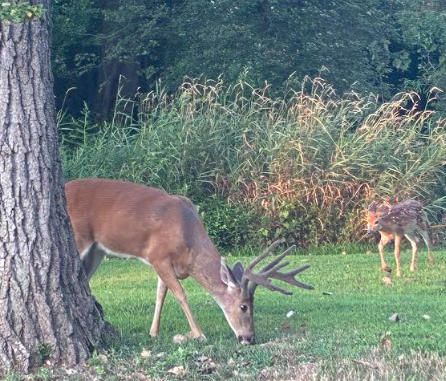
I love Bambi, you love Bambi, we all love Bambi! Should we kill Bambi? What if I told you that Bambi and his family are overpopulating and beginning to cause deadly driving situations and severe ecological damage? Not so cute anymore, huh? It goes without saying that there are naturally a lot of deer in and around Cresskill. Anyone who finds themselves in the great outdoors once in a while can attest to that. Usually, these deer are free to just do their own thing, separate from humans, and seldom causing problems for anyone. We are now, however, witnessing a departure from this status quo: the deer population is exploding in size and number.
In our humble suburban neighborhoods, in creating the perfect habitat for human families through parks, small forests, and large backyards, we unknowingly foster an even better environment for families of the deer variant. These deer have access to ample food (from grass to gardens, an issue we’ll get to later), water, and shelter throughout these towns, a recipe for deer population disaster. A comfortable life for ten deer soon becomes a comfortable life for forty, and it really just snowballs from there. Senior Ryan Honczarenko explains that “There are definitely more deer now, especially in my backyard. My mom likes feeding them, but there’re just so many everywhere.” The issue is no longer one we can just look past. These deer are becoming furry, white-tailed ecological disasters!
Deer eat plants. Crazy, I know. But the thing is, when there are as many deer roaming around the town as there are now, they eat a lot. So much so that it leads to the decimation of native plant species populations as a result! Native tree species like hickory, oak, and dogwood are breakfast, and native flowers like Goldenrod are lunch. When the deer overgraze on these plants, other animals that rely on them for nourishment like the humble chipmunks and squirrels to birds and rabbits can’t fill their stomachs, hurting their populations. Think about it, when’s the last time you’ve seen a bunny around here, and those things are known for multiplying? Of course, if you think these appetites don’t directly hurt you enough, think again. For dinner? These gutsy ungulates (hooved animals) will stroll into your backyard for a hearty vegetable meal. Nothing is safe! Fruits, flowers, herbs, nothing! Sophomore Hannah Barrs recounts her home garden of plants like cucumber, tomatoes, and strawberries meeting an unfortunate end: “The deer were just eating everything we planted, to the point where we had to put a cage over our garden. Even this measure didn’t work, and we sadly gave up gardening as the deer and other creatures kept on eating.” As you can see, even drastic measures fail in protecting your harvest from their hooves.
But why is this even such a big problem in the first place? Why are there just so many of these things? Well, there are a lot of answers to that question. The biggest factor is most likely the lack of predators for the deer here in Bergen county. The only animals capable of preying on anything the size of a deer around here are black bears and coyotes, both of which are incredibly rare, the two species seldom targeting deer already. Only adding fuel to the fire are the protections provided to the deer. As many know, deer hunting is strictly forbidden in much of New Jersey, but especially so in Bergen County. Killing them is illegal in almost all cases, meaning they’re protected from humans while going about their lives.
Funnily (or not) enough, the only real threat these deer face are bad drivers. In 2022, there were 222 deer accidents in Bergen County alone, a number that has seen increases every year since. Deer are often injured, maimed, or even killed in these brutal accidents. What’s more is that the humans involved are forced to pay hefty repair fees on cars, and in extreme cases, hospital bills. Some even lose their lives. The more deer present, the greater the chances are for such tragedies to occur.
And as icing on the cake, these deer provide food for nasty species of ticks that not only latch on to unsuspecting deer, but also humans and our furry friends, spreading lyme disease and a host of health detriments. Yuck.
Solving this issue is… divisive. The scrappy, intelligent nature of these deer means you can’t just avoid leaving food out and take your trash in; they’ll find more food. What many have suggested, and many have criticized, is the culling (that is to say the reduction of a population by eliminating members) of deer in specific areas across Bergen county. This would take a load off the ecosystems of many forested towns, such as Saddle Brook, which has reported a deer per square mile density of 42, 4 times over the ecologically sustainable level! A while ago in September, a meeting took place in Pascack Valley with representatives from over 10 neighboring towns on the topic of the deer population. A culling project was discussed, which would include setting up bow hunters in tree stands to selectively pick off deers, in order to fix a lot of the aforementioned issues in these towns. The plan is still in the air, but it no doubt acts as an example of what could be. Establishing a firearm (but more likely bow, on account of its silent nature) hunting season for deer in Northern Valley may help in reducing the rampant populations, all while giving the hunting community a new frontier and boosting local sport store success. An anonymous student explains that “As an avid hunter outside New Jersey, I’d love to see more opportunities to hunt close to home, especially considering how much I could contribute to cutting down overpopulation.” Naturally, some adopt a more reluctant stance. Freshman Andrew Daly admits that “I don’t think we should kill them, but neutering deer could help us control the issue.”
Where do we go from here? No one wants to hurt Bambi, but this problem is an urgent one. Hopefully we’ll see some change soon, but through it all we must traverse very carefully, and consider all perspectives. Some people are okay taking a more active role in reducing deer numbers, while others want us to figure out a way to coexist in peace. Until we figure something out, make sure you’re careful when driving near sunset, and keep an eye on that prize rose bush out in the garden. You never know when a couple passerbys may convert your commendable crop into calories!