

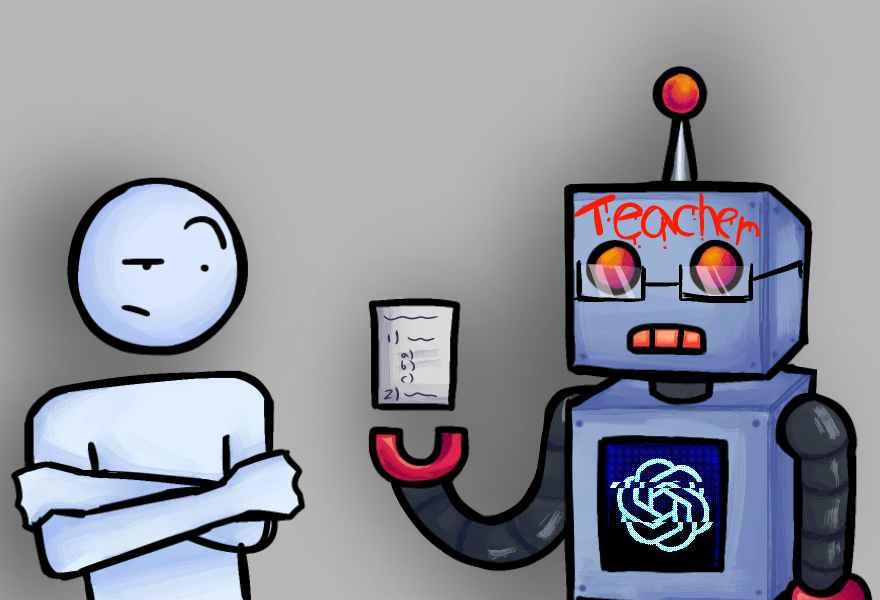
Imagine opening a worksheet or slideshow and noticing that everything is perfectly worded, neatly organized, and almost too polished. Some students might pause and wonder, did my teacher write this, or did AI help? As artificial intelligence tools like ChatGPT become more common, they are increasingly being used not only by students, but also by teachers. This raises an important question: can students tell when teachers use AI, and does it matter?
Many teachers say they use AI as a tool, rather than a replacement for their own ideas. Mr. Surgent, a history teacher at CHS, explained that he turns to AI when he already has a project idea but needs help organizing it. He often gives AI long prompts describing the project requirements, outcomes, and grading criteria. AI then helps turn those ideas into a clear, student-ready assignment. According to Mr. Surgent, AI saves time on formatting and typing, but the core ideas always come from him. He emphasized this point when he said, “It’s definitely not replacing my original thoughts; it’s more like dictation or organization,” he said.
Mr. McCaffrey, a video teacher at CHS, shared a similar perspective. He explained that AI helps him rewrite assignment descriptions so they are easier and more engaging for students to read. Describing his experience, he said, “I could write a really detailed document that makes sense to me, but students might get bored or confused.” By using AI to improve clarity and layout, he noticed that students understood expectations better and included more required elements in their projects. He also uses AI for grammar, punctuation, and proofreading, especially for recommendation letters and long project descriptions.
While teachers see AI as a helpful support, students often say they can tell when it is being used. Manav Amin, the freshman student representative, explained that AI use becomes obvious through formatting and tone. Speaking from personal experience, he stated, “I use AI pretty frequently, so I know when teachers use it.” He continued by explaining, “It’s the way it’s formatted and how it reads.” Manav believes AI can be useful, but when noticing it, his respect for the class is slightly lowered. Still, he emphasized that his respect for teachers like Mr. Surgent remains strong because they use AI thoughtfully.
Other students shared similar observations. Freshman Drew Chung said AI often shows up in emails or sample paragraphs, sometimes making the writing feel too perfect or impersonal. Furthermore, Freshman Alex Stogliogiou noticed AI in study guides and slideshows, sometimes even leaving in emojis or unusual formatting. Describing how noticeable it is, he said, “It’s pretty easy to tell because it’s different from the other lessons.” However, Alex also mentioned that it doesn’t particularly bother him when teachers use AI.
Both commenting teachers agreed that transparency and intention matter. Mr. Surgent believes students can tell when assignments are made quickly with AI and lack depth. He explained this by saying, “When AI is used (for) busy work, it doesn’t hit the same.” He added that higher-level projects requiring creativity and synthesis are harder for AI to fake, and that he can often tell when students rely too heavily on AI as well.
Mr. McCaffrey also stressed that context matters. He compared careless AI use to lazy AI art or videos, explaining, “If you just copy and paste from AI, that’s lazy.” He followed up by stating, “That shouldn’t be modeled for students.” However, he believes using AI to revise, clarify, and improve work is ethical and valuable. He also emphasized the importance of honesty. While he does not always announce AI use, he is open about it when students ask and believes teachers should model responsible behavior.
A common theme among students, especially upperclassmen, is fairness. Many students believe that if teachers are allowed to use AI, students should be allowed to use it as well. Both Mr. Surgent and Mr. McCaffrey agreed with this idea, as long as AI is used as a tool rather than a crutch. Mr. McCaffrey suggested that limited AI use, around twenty to twenty five percent, is reasonable for everyone, as long as it supports learning instead of replacing it.
In the end, can students tell when teachers use AI? Often, yes. Students notice patterns, formatting, and tone changes. But when AI is used carefully, edited thoughtfully, and combined with a teacher’s personal knowledge of their students, it becomes less noticeable and more effective. In the end, it’s clear that both students and teachers agree on one thing: AI should enhance learning, not replace effort or creativity.