
As hundreds of exhausted students begin to fill the bleachers, the secretariat struts up to the tiny podium. While adjusting her shirt, she taps the mic several times, a futile attempt to hear herself amidst the cacophony of voices. Defeated, she turns her head over to the two faculty members, who had just finished neatly laying out dozens of certificates across a white plastic table. A sharp nod from both of them prompts the secretariat, after clearing her throat, to give one last announcement.
“We will now begin the awards ceremony.”
Almost immediately, a deafening silence sweeps through the audience. Once droopy, sunken eyes suddenly widen; hundreds of eyes rapidly lock onto the massive screen. The echo of students’ voices linger throughout the auditorium, an eerie reminder of the once lively atmosphere. As she begins to grab the television remote, tensions begin to spike. Teeth begin clenching, hearts begin to race. Then, in one swift motion, she clicks the remote.
Academy Model United Nations. Held annually at the prestigious Bergen County Academies, it is one of, if not the most anticipated event for MUN members throughout dozens of schools. Early each year, hundreds of students from different schools gather to debate a plethora of different topics in their respective committees, with topics ranging from something as simple as foreign policy to martian zombie viruses (what?).
Each conference is split into two days and further divided into four 1-2 hour sessions. Typically, at the start of the first session, delegates have the opportunity to vote on their desired topic and present their delegation’s perspective on that topic. Throughout the following sessions, delegates argue back and forth on how to deal with the issue at hand, ultimately forming blocs, or groups of delegations who share similar opinions, which write resolutions on how they believe the issue should be resolved. However, for committees like CRISIS, each student represents an individual, either historical or fictional, and is expected to deal with a fast-changing atmosphere where the issue constantly changes. It’s a special committee dominated by secret plots, war, and immediate action.
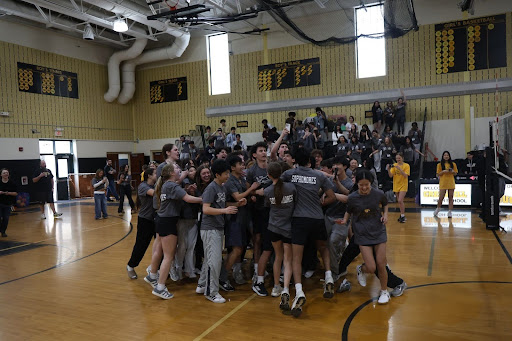
And of course, the awards. After every conference, each committee gathers back into the gymnasium for a closing ceremony, which includes the declaration of awards and their recipients. This year, 7 delegates from Cresskill received awards: several received certificates for Verbal Commendation and one even earned the revered Best Delegate.
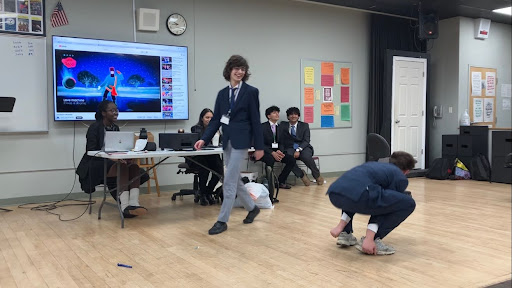
As a student who attended the conference this year as a representative of France in DISEC (the Disarmament and International Security Council), I highly recommend joining MUN, mostly to attend this event. While I did have a good time at the in-house conferences, I believe nothing can top my experience at AMUN. It is genuinely one of the most fun that I’ve ever had throughout my entire school career. One of the most memorable events from this whole experience was Fun MUN, a series of entertaining activities that occurs after the topic is resolved. For DISEC, this year, co-chair Jason Goodman was pitted against the delegation of Italy in a fierce dance battle to Rasputin. Other committees enjoyed activities such as hot chair, with some even getting the opportunity to barge into other committees’ Fun MUNs. You also can’t forget about candy grams. Available to purchase for $1 at the cafeteria during lunch break, you can write messages and send them to any delegate of your choice, with the messages being read out loud by the chair and secretariat.
Others also expressed their fondness for this event. Daniel Mao, representing Piero Ferrari for JCC B, a crisis committee, also stated that this year’s AMUN “was really fun… [he] especially loved sending messages to his friends with the candy grams.”
Overall, this was an amazing, spectacular experience. I highly recommend this event, and immensely encourage others to join MUN.